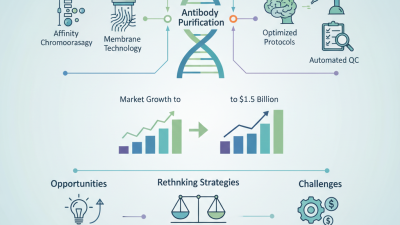
How to Choose Antibody Purification Technology?

Choosing an Antibody Purification Technology is a process decision, not a simple equipment purchase. The right platform must protect antibody activity, purity, yield, and manufacturing continuity. It must also fit the molecule, scale, budget, and regulatory strategy. A method that works in a research tube may fail inside a 2,000-liter bioreactor workflow. Small differences matter. Binding capacity, residence time, pressure, and buffer volume can change the final result.

Industry evidence shows why this choice deserves careful analysis. BioPlan Associates’ 2024 Annual Report continues to identify downstream processing capacity, cost, and process intensification as major biomanufacturing concerns. Grand View Research also reports sustained growth in the global antibody production market, increasing pressure on manufacturers to improve efficiency and scalability. These findings support a practical view: Protein A chromatography remains a strong capture option, but it is not automatically the best answer for every antibody. Precipitation, membrane filtration, ion exchange, and mixed-mode chromatography may reduce cost or improve selectivity in specific workflows. Sometimes, they create new problems.

There is no universal winner. My experience with purification planning suggests that early screening should compare recovery, aggregate levels, host-cell protein clearance, buffer demand, and resin lifetime. A clear decision matrix helps. However, published performance data may not fully represent your molecule or facility. That limitation deserves attention. Pilot-scale testing, orthogonal analytics, and documented risk assessment can reveal hidden trade-offs before commercial investment. This guide explains how to compare technologies with evidence, realistic operating details, and appropriate caution.
How to Choose Antibody Purification Technology?

Define the Antibody Purification Goal and Product Requirements

Choosing an antibody purification technology begins with a clear product definition. Start by listing the intended use, dosage form, development stage, and release timeline. A research reagent needs different controls from an injectable therapeutic.

Define critical quality attributes before comparing platforms. ICH Q6B emphasizes identity, purity, potency, and safety-related characteristics. These requirements determine acceptable host-cell proteins, residual DNA, aggregates, endotoxin, and viral contaminants. Set numerical limits early. Otherwise, “high purity” remains too vague.

BioPlan Associates’ 2024 Annual Report and Survey of Biopharmaceutical Manufacturing, based on responses from more than 200 industry professionals, identifies downstream capacity and process efficiency as continuing manufacturing priorities. This supports a practical question: can the method handle the expected titer, batch size, and future scale? A purification train may perform well at laboratory volume yet lose yield during scale-up. That happens more often than teams admit.

Document recovery targets, buffer consumption, cycle time, resin lifetime, and cleaning requirements. Include analytical comparability across development batches. The European Medicines Agency’s biotechnology guidance also stresses control of process-related and product-related impurities. Do not choose a platform only because its chromatogram looks clean. Consider manufacturability, supply resilience, operator safety, and validated control strategies. Some decisions will remain uncertain. Record those assumptions, then test them with small-scale studies and stress conditions.

Compare Core Antibody Purification Technologies

Choosing antibody purification technology requires more than comparing binding capacity. It requires matching impurity risk, product stability, scale, and manufacturing cost. Protein A chromatography remains the usual capture step because it offers high selectivity and strong productivity. However, resin costs, ligand leakage, and low-pH viral inactivation can challenge sensitive antibodies. BioPlan Associates’ 2024 biopharmaceutical manufacturing survey identified downstream processing as a significant bottleneck for roughly 60% of respondents. That figure supports careful process design, not automatic technology selection.

Ion-exchange chromatography often provides efficient polishing at lower material cost. Cation exchange can remove aggregates, while anion exchange supports impurity and viral clearance under suitable conditions. Mixed-mode resins add wider selectivity, but their operating windows may be narrower. Membrane adsorbers can improve throughput and reduce buffer use, especially during flow-through polishing. The trade-off is real. Capacity may fall when feed variability increases. Data from the 2024 industry report by BioPlan Associates also shows continuing pressure to improve facility flexibility and reduce processing time. Those priorities favor modular steps, but not every molecule benefits equally.

In practical development, compare host-cell proteins, DNA, aggregates, endotoxin, yield, and clearance across several feed conditions. Measure performance after repeated cycles. Small-scale results can mislead. A robust process should tolerate modest pH, conductivity, and concentration changes without losing critical quality attributes. Grand View Research’s 2024 antibody market analysis describes sustained demand for monoclonal antibody production, yet market growth alone does not justify complex purification trains. The best choice is usually the simplest sequence that meets specifications reliably, although this assumption deserves regular review.

How to Choose Antibody Purification Technology? - Compare Core Antibody Purification Technologies

Technology Separation Principle Best Fit and Selectivity Key Limitations Typical Process Role
Protein A Affinity Chromatography Specific binding between the Fc region of many immunoglobulin G molecules and an immobilized Protein A ligand. High selectivity for many mammalian-cell-culture-derived IgG antibodies, especially during capture. High selectivity
High binding capacity is commonly available; combines capture and substantial impurity reduction in one step; well established for monoclonal antibody processes.
Ligand and resin costs can be high; acidic elution may promote aggregation for some antibodies; performance varies with antibody subclass and Fc structure; host-cell proteins, DNA, viruses, and aggregates may require additional steps. Primary capture
Protein G Affinity Chromatography Specific interaction between the Fc region or selected Fab-related sites of immunoglobulins and an immobilized Protein G ligand. Useful for antibody classes or subclasses that bind weakly or poorly to Protein A; often valuable for research-scale purification and screening. High selectivity
Broad binding profile for several immunoglobulin types; can improve recovery when Protein A shows weak binding.
Generally less favored for large-scale monoclonal antibody capture because of cost, cleaning considerations, and process-specific capacity; binding remains dependent on antibody species and subclass. Alternative capture or laboratory purification
Protein L Affinity Chromatography Binding to compatible immunoglobulin light-chain variable regions, usually without requiring an intact Fc region. Selected antibodies, antibody fragments, and molecules with suitable kappa light-chain configurations. High selectivity
Can purify Fab, scFv, and other fragments that do not contain an Fc region; useful for difficult antibody formats.
Not universal: binding depends strongly on light-chain type and variable-region structure; typically less suitable as a generic platform step for all antibodies. Specialized capture
Cation-Exchange Chromatography Positively charged resin binds proteins that carry a net positive charge below their isoelectric point; elution is controlled by salt or pH. Antibodies whose charge properties allow selective separation from host-cell proteins, aggregates, or charge variants. High versatility
Effective polishing or intermediate purification; supports separation of charge variants and can provide good impurity clearance without affinity ligands.
Selectivity depends on pH, conductivity, resin chemistry, and antibody pI; optimization may be substantial; some antibodies bind weakly under practical conditions. Intermediate purification or polishing
Anion-Exchange Chromatography Negatively charged resin binds proteins and other impurities that are negatively charged under the operating conditions. Often suited to flow-through polishing, where the antibody does not bind strongly while acidic impurities, DNA, endotoxin, or viruses are retained. High impurity clearance
Useful for host-cell protein, nucleic-acid, endotoxin, and selected viral clearance; flow-through operation can reduce product residence time.
Performance is highly sensitive to pH and conductivity; antibody binding may occur if conditions are not properly selected; usually not a stand-alone capture method. Polishing or flow-through viral clearance
Hydrophobic Interaction Chromatography Separation based on differences in surface hydrophobicity. High salt promotes binding, and decreasing salt enables elution. Aggregates, fragments, and hydrophobic product-related variants that differ sufficiently from the main antibody species. Good orthogonal selectivity
Can separate species that are difficult to resolve by charge-based methods; useful for aggregate and variant control.
High salt can affect product stability and requires additional buffer handling; method development may be complex; capacity and recovery are molecule dependent. Polishing
Mixed-Mode Chromatography Combines two or more interaction mechanisms, such as ionic, hydrophobic, and hydrogen-bonding interactions. Complex impurity profiles or antibodies requiring an orthogonal polishing step after affinity capture. Broad impurity selectivity
Can remove host-cell proteins, aggregates, DNA, leached ligands, and charge-related impurities in a single step when properly optimized.
Mechanisms can be difficult to predict; pH, conductivity, and loading conditions strongly influence selectivity; process development often requires systematic screening. Intermediate purification or polishing
Size-Exclusion Chromatography Porous particles separate molecules according to hydrodynamic size, with larger molecules eluting before smaller molecules. Small-scale separation of monomers, dimers, aggregates, and fragments when high resolution is needed. High resolution
Gentle, isocratic operation; does not require product binding; useful for analytical characterization and final laboratory-scale polishing.
Low productivity and limited loading capacity; substantial dilution is common; generally unsuitable as a primary industrial capture step. Analytical or small-scale polishing
Membrane Adsorbers Convective transport through functionalized membranes enables adsorption based mainly on charge or affinity. High-throughput removal of DNA, endotoxin, viruses, or selected host-cell impurities, especially in flow-through mode. High throughput
Low diffusion limitations, short residence times, convenient scale-up by membrane area, and suitability for disposable or intensified processing.
Binding capacity and selectivity can be lower than those of optimized resin columns for some targets; fouling and feed quality can affect performance. Flow-through polishing or viral clearance
Ultrafiltration and Diafiltration Pressure-driven membrane separation based primarily on molecular size; diafiltration exchanges the product buffer. Concentration, formulation exchange, and removal of low-molecular-weight components after chromatographic purification. Strong process utility
Efficient for concentration and buffer exchange; readily integrated near the end of a purification process; does not require a binding ligand.
Does not normally provide the same fine impurity selectivity as chromatography; shear, concentration polarization, adsorption, and aggregation must be controlled. Concentration and formulation

Selection note: A robust antibody purification process commonly combines orthogonal mechanisms: affinity capture for selectivity, ion-exchange or mixed-mode chromatography for impurity and variant control, and membrane-based operations for concentration, buffer exchange, or high-throughput clearance.

Match Purification Methods to Antibody Properties

How to Choose Antibody Purification Technology?

Match the purification method to the antibody’s properties, not just the expected yield. Start by checking its isotype, size, charge, affinity, and stability. An Fc-containing antibody often suits Fc-selective affinity capture. Other antibody formats may require charge-based or ligand-based separation. Ion-exchange methods can remove host-cell proteins and nucleic acids when the antibody’s isoelectric point is known. Size-exclusion chromatography is gentle, but it may reduce recovery during larger-scale processing. It also separates aggregates from monomers. The sample matrix matters too. Serum, cell culture fluid, and clarified lysate create different purification challenges. A practical choice is rarely perfect.

Tips: Use a small screening experiment before scaling. Compare purity, recovery, concentration, and aggregate levels. Watch the buffer’s pH and salt carefully. Small changes can affect binding. Keep a written record of every result. Failed trials still provide useful evidence.

For fragile antibodies, reduce exposure to extreme pH, strong salt gradients, and repeated freeze-thaw cycles. A two-step workflow is often more reliable than forcing one method to do everything. Affinity capture can provide selectivity, while ion exchange or mixed-mode chromatography improves polishing. If the antibody binds weakly, extending contact time may help, but it can also increase degradation. I have seen high purity hide poor recovery. That result needs a second look. Final selection should reflect the intended use, required purity, available equipment, and process scale. Test the method under realistic conditions, not only in a clean laboratory sample.

How to Choose Antibody Purification Technology?

Match purification methods to antibody properties using a relative suitability score from 1 (limited fit) to 5 (strong fit).

Protein A and Protein G are commonly used for Fc-containing IgG capture. Ion-exchange chromatography is useful for charge variants and can support Fc-free antibody fragments. Size-exclusion chromatography is mainly used for aggregate removal and polishing, while tag-based affinity methods are selected when a recombinant antibody carries a compatible purification tag. Actual performance depends on species, subclass, pI, buffer conditions, and resin capacity.

Evaluate Process Performance, Cost, and Scalability

Choosing antibody purification technology requires more than comparing yield percentages. Process performance should include purity, aggregate removal, host-cell protein reduction, viral clearance, and cycle time. BioPlan Associates’ 2024 Annual Report, based on feedback from hundreds of biomanufacturing professionals, highlights capacity, process consistency, and supply resilience as continuing industry concerns. Test each candidate with representative feedstock, not only clarified laboratory material. Small differences become visible at harvest scale.

Cost deserves a wider lens. Include resin lifetime, buffer volume, labor, waste treatment, cleaning, testing, and equipment utilization. A lower purchase price may hide expensive rework. The 2024 Deloitte Global Life Sciences Outlook also identifies manufacturing productivity and supply-chain resilience as major investment priorities. Build a model for at least five years. Then challenge it. Forecasts are often too optimistic.

Scalability is practical, not theoretical. Compare residence time, column diameter, membrane area, mixing limits, and facility footprint. Record pressure changes during repeated cycles. Check whether performance remains stable after scale-up and long storage. A process that works at one liter may struggle at 2,000 liters. It happens. BioPlan’s industry reporting repeatedly emphasizes the value of flexible capacity and reliable production planning. Therefore, score technologies using measured data, risk ratings, and sensitivity ranges, rather than one attractive yield number. Perfect certainty is unrealistic. Weak assumptions should remain visible.

Select and Validate the Most Suitable Purification Workflow

How to Choose Antibody Purification Technology?

Selecting and validating a purification workflow requires more than comparing recovery percentages. Start with the molecule’s behavior, impurity profile, and intended scale. Protein A often supports efficient capture, while ion-exchange, mixed-mode, and membrane steps can improve impurity clearance. However, the best sequence depends on aggregate levels, host-cell proteins, residual DNA, endotoxin, and product stability.

Grand View Research estimated the global protein purification market at approximately USD 8.6 billion in 2023, with continued growth expected through 2030. This expansion reflects demand for scalable and reproducible workflows. Yet market growth does not validate a process. The FDA’s Process Validation guidance recommends linking critical quality attributes with critical process parameters. Small-scale studies should therefore test binding capacity, residence time, pH, conductivity, yield, and resin lifetime. One strong chromatogram is not enough.

Tips: Build a design-of-experiments matrix instead of changing one factor informally. Include stress testing and hold-time studies. Compare at least two purification routes when raw material variability is high. A high recovery number can mislead. I have seen workflows lose value after polishing, because extra steps increased handling and reduced overall yield. Define acceptance criteria before experiments begin, then challenge them with real process variability. Validation should confirm robustness, not simply reproduce a successful laboratory run.